
After the DSP: Ad Tech 3.0 and the Unified Media Platform
Five capabilities a complete Unified Media Platform has to deliver, and why the next wave of ad tech shifts from channel optimization to portfolio optimization.
By Tom Kelly, Co-Founder and CRO, Neural Ads
Every decade or so, ad tech produces a next big thing. Each time, it looks like a niche to most of the industry, and each time, the companies that saw it early end up defining how trillions of dollars of media get bought. The next one has already started. Most of the market just hasn't named it yet.
Spend more than 20 years in one industry and you become a student of its patterns. Spend them on the front lines and you also live through those patterns, more than once. Having helped build parts of the first two waves, I recognize the early signs of the third.
Ad tech has reinvented itself twice since the first banner ad ran in 1994. Ad tech 1.0 was the ad networks of the late 1990s and early 2000s, companies like Advertising.com and ValueClick, which solved publisher fragmentation by putting thousands of sites behind one relationship and brought some of the first machine learning models to ad buying.
Ad tech 2.0 arrived between roughly 2007 and 2010, and its big idea was self-service. Instead of buying through a network's black box, buyers and sellers got their own tools, and an entire generation of "xSPs" was born: demand-side platforms (DSPs), supply-side platforms (SSPs), and data management platforms (DMPs), connected through real-time, auction-level exchanges. Over the following decade, CTV and retail media reshaped the DSP again.
Each wave solved the last wave's problem and quietly created the next one. Networks created the black box. DSPs created channel fragmentation: social, CTV, and retail media each became its own closed, DSP-like environment. And through both waves, planning and measurement were left out of the fix.
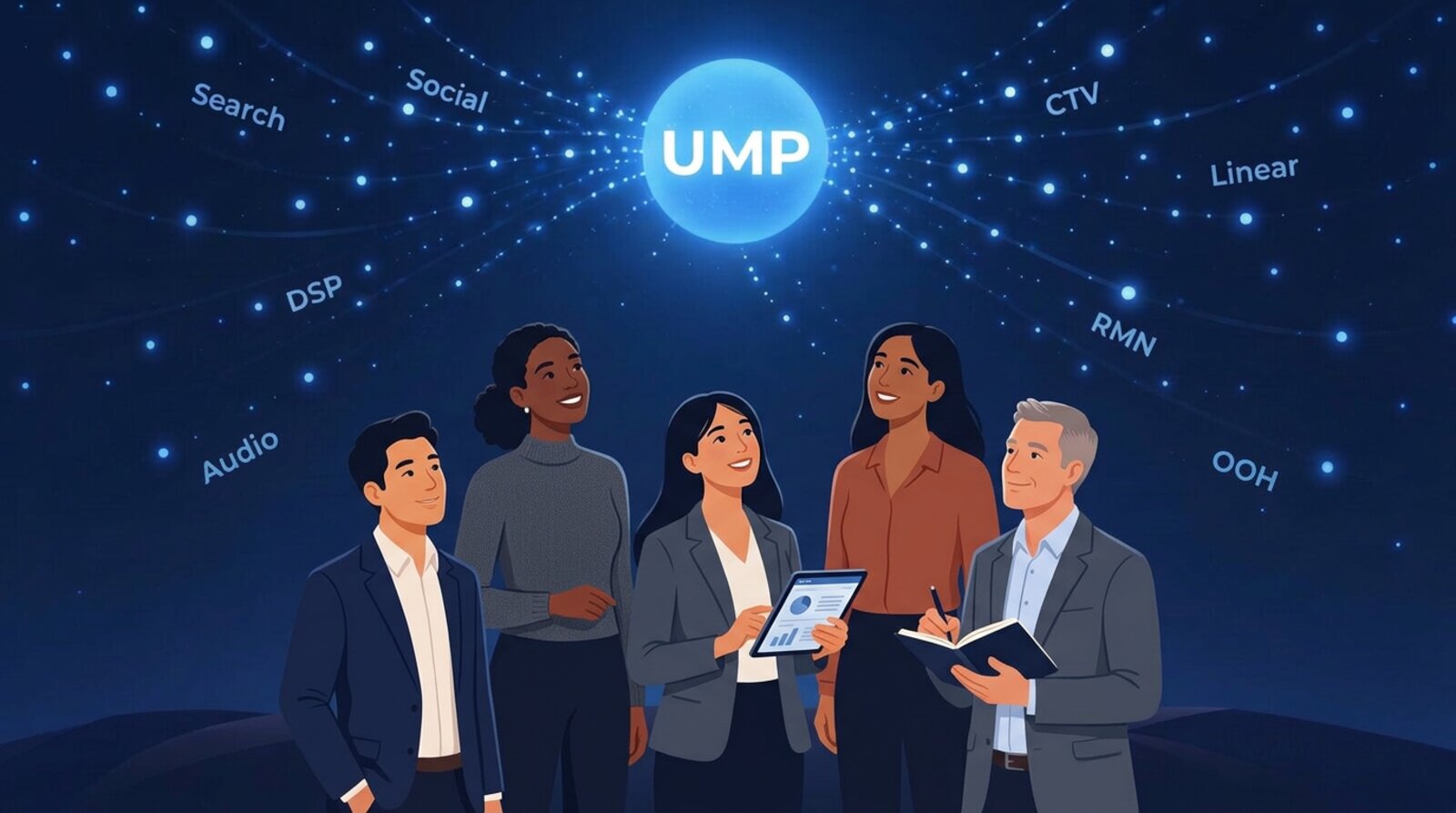
The third wave is here, and it finally has a name. Last month, Aperiam Ventures published the first market map for what it calls Unified Media Platforms, or UMPs: systems that connect directly to media supply, sit under one interface, and run planning, execution, measurement, and optimization through an AI decision engine. Others have since argued that marketers need to manage media like a portfolio, and that a UMP's defining feature is advanced measurement, including marketing mix modeling, built from the ground up.
The attention is good for everyone building in this space. Naming a category is the first step. The next is agreeing on what it has to deliver.
That matters because the real competition isn't between the startups in this category. It's the legacy stack: a separate DSP, a separate console for every walled garden, a quarterly MMM deck, and last-click attribution holding it all together. The new platforms are attacking that stack from different angles, some from creative, some from orchestration, some from data, and that variety is healthy. But if the industry doesn't agree on what "unified" means, incumbents will put a new label on old tools, and buyers will be right to stay skeptical of the whole category.
What follows is a proposal for that conversation: five capabilities a complete UMP has to deliver. They work less as a gate and more as a maturity model for the category, a shared description of where it's headed.
1. One loop, built from the ground up
Planning, buying, and measurement live in one native system, and each informs the next while campaigns run. A dashboard stitched over separate consoles is not this, and neither is a planning deck that gets rekeyed into five buying tools. The test: does the plan become the buy without a handoff, and does what the buy learns change the plan?
It starts with the plan. Media planners have never had bottoms-up, bid-stream level data or real audiences to work with. Plans were built on panels and averages, without knowing what inventory and audiences were actually available to buy, and then handed off to buying teams to make reality fit. Bringing that data into planning changes the job: plans are built around what the market can actually deliver, in far greater detail, instead of in isolation from it.
2. The platform builds the audience
Machine learning targeting has to be native. If audiences are lookalikes borrowed from each walled garden, the platform is a pass-through, and every channel is still optimizing against its own interests. A UMP builds audiences from the advertiser's data and its own models, and carries them across channels.
It also raises a simple question: why rent your data when you can own it? Today most advertisers pay, campaign after campaign, to rent third-party segments inside each platform, and the learning stays with the platform when the campaign ends. Audiences built as first-party assets cost less over time, stay under the advertiser's control, and travel with the plan. Just as important, the same audience can be bought in every channel, which is the only way to compare channels like for like.
3. Buying across the plan, not across a DSP
The DSP was supposed to buy everything. It never did. Social, retail media, and linear TV kept their data and decisioning behind their own walls. A UMP has to reach where budgets actually go: social, retail media, programmatic and CTV, linear, and publisher direct. Two walled gardens is not omnichannel. Neither is one DSP.
Breadth has a second payoff: supply path optimization stops being a product. In the 2.0 stack, SPO is often sold as a paid add-on, a fix for the fees and resellers that pile up between a buyer and the impression. When a platform can reach the same audience through many channels and paths, it can simply choose the one with the fewest hops. SPO becomes a natural result of how the buy is made, and it should be table stakes, not a line item.
4. Measurement from the bottom up
This is the hardest of the five, and the one that matters most. MMM has historically been built on panel data and aggregate spend, and it lands a quarter late, after the budget it should have shaped is already spent. Last-click is worse: it hands all the credit to whatever ran last. A UMP feeds granular, impression and bid-stream level delivery data into its MMM and updates it in flight, so allocation follows what is actually incremental, not what each platform reports about itself.
5. Creative that moves with the plan
Creative has always been an afterthought in ad tech. Platforms were built to decide where and when an ad runs, and the ad itself was left to someone else's workflow. Yet creative is the only part of the entire process a customer ever actually sees, and it is arguably the most important lever in the plan. Every placement has its own spec, audience, and context. A UMP generates and optimizes creative inside the same loop, so creative performance informs allocation, and allocation informs creative.
The common denominator
Underneath all five sits one requirement: a common denominator. Today every channel counts in its own currency. A walled garden's conversion, a CTV impression, and a retail media sale are defined differently, measured by different parties, and reported in different places, so comparing them is guesswork. A standard has to apply across every channel: one consistent cohort, defined once and carried everywhere, that can be reported on, compared, valued, and measured the same way no matter where the media ran. Without that common denominator, a platform can put every channel on one screen and still not be able to say which one is working.
Why these five
The problem UMPs exist to solve is not too many logins. It is that budget moves across channels on weak evidence, decided by siloed teams, in a process that does not learn. Call it the shift from channel optimization to portfolio optimization. You can't manage a portfolio if you can't measure every holding on the same terms, and you can't rebalance it if you can only buy a few of the assets.
Most of the new platforms in this space are already strong on several of these, and the category is better for it. Orchestration across walled gardens saves teams real hours. Generative creative is a real leap. The point of a shared bar isn't to rank each other. It's to give buyers a simple way to tell a platform built for this wave from a legacy tool with a new label, and to give all of us something to build toward.
At Neural Ads, we chose to start with the hardest one. We built measurement first, then built buying around it: one plan, set up once, executed natively across social, retail media, programmatic display and video, CTV and streaming, and curated publisher marketplaces, with new channels added every month, with proprietary MMM deciding how much each channel should get in the first place, and learning from every impression instead of resetting every quarter. Starting there is a bet that once buyers can see what's truly incremental across every channel, everything else in the stack has to answer to it.
Every wave rewards the teams that move before it's obvious. If your media is still planned in one tool, bought in five, and measured a quarter late, there's a better way, and it's available today. Whether you want to learn more about UMPs or see an AI-native approach to planning, buying, and measurement firsthand, let's connect.
Tom Kelly is Co-Founder and Chief Revenue Officer of Neural Ads. He was part of ad tech 1.0 at Advertising.com, arguably the first true ad network; ad tech 2.0 at The Trade Desk, where he helped scale the business and built and launched the Walmart DSP; and now ad tech 3.0 at Neural Ads.